Care After Death is the title of a training course that we run at work for staff members outside of the mortuary who may come into contact with deceased patients in their line of work. Often those staff are frightened or they simply do not understand why on Earth they need to attend the mortuary for training. While it is important to see what the mortuary is really like and dispel the myths of it being cold, dark and smelly (if you have visited other mortuaries which are like this I can only apologise, they really do not need to be), there is another aspect we hold dear. The big message we try to get across in this is that, first and foremost, the care of the hospital patient does not cease when they die. The upmost dignity and care is provided of which we are proud of and discuss openly as we feel it gives confidence to families that their loved ones are in safe hands. What some people assume happens once somebody dies is sadly quite far removed from the truth.
However, I am writing this post as something has been playing on my mind ever since I have been on maternity leave. One thing looking after a baby affords is an incredible amount of time to think. Indeed to overthink in many cases, but the thoughts come in floods at times, and they evolve.
I find myself wondering why do we live at a time when still there are those who seek to profit, gain or benefit from the deceased rather than look after them. Why are people like me still needing to argue that the dead are worthy of dignity and care.
It is an ultimate truth that the deceased are of the many vulnerable people in society. They cannot speak up or even recount what has happened to them, which is why it is important that someone advocates for them at this time. There are a great number of people out there who we trust with our deceased, either through the legal or medical system, or through organisations and paid companies who tend to them before and after their funeral.
Yet, it is a terrible truth that there are people who do awful things when it comes to the dead. The can take advantage of families at a tragic and stressful time and/or seek to gain monetarily from the deceased themselves. They can also make promises of services provided that cannot be upheld, and discovered only when it is too late. It has long been tradition that funerals can be lavish and often outside of what people can afford yet feel they need to provide. I will add that people too, thankfully rarely, can physically abuse the deceased for their own personal horrific gain as is currently under examination by the Fuller Inquiry.
I can only reason it is like with any underhand deed for gain, because they believe they can act without being found out. Or the lure of gain, money or otherwise, is too strong. The sheer number of people who die, especially in built up areas and cities it can only be too tempting for those who devise a way of making the most money from each one. From the early days of funerals, to the exquisite mourning warehouses of the Victorian period and the body snatchers, historically there is money to be made in death. Yet why do people exploit this when we all know that a mark of humanity itself is to care for the dead, and not many would want themselves or their loved ones to be exploited or treated with anythubg but dignity and respect. I feel this should be felt more strongly since the pandemic hit and did it’s worst, and we are at the best time to be able to provide a dignified existence after death when we all remember the constraints of lockdown restrictions around funerals and mourning.
Sidenote- ‘dignified existence’ would mean very different things to different people depending on personal wishes and potentially religious beliefs. However I believe, and use it hereon the understanding, that there is a basic standard of being as clean as possible, covered (not naked but also wrapped so not exposed in any way and least damaging to the body), and in storage which is suitable.
Largely as society, while we are shocked and appalled by the stories in the media which expose horrible occurrences, there is an apathy towards prevention or actually doing anything in response. Whether this be because is is an unsavoury subject to discuss, or because truly we only care when it is our personal loved ones who are affected, I do not know. Although I think it is sensible to assume both are applicable and in probably equal measure. It can be difficult for us to respond actively to anything until we are personally affected in some way.
I’d be interested to hear people’s thoughts on this, from those in the death industry (a term I use now with some hesitation considering it perhaps implies profit of some extent) and those outside of it. If you are reading this, I imagine you are either working with deceased or have a morbid curiosity and an inclination already towards care being of importance. Yet I think it may be interesting for it to be a discussion with those not in either of these groups.
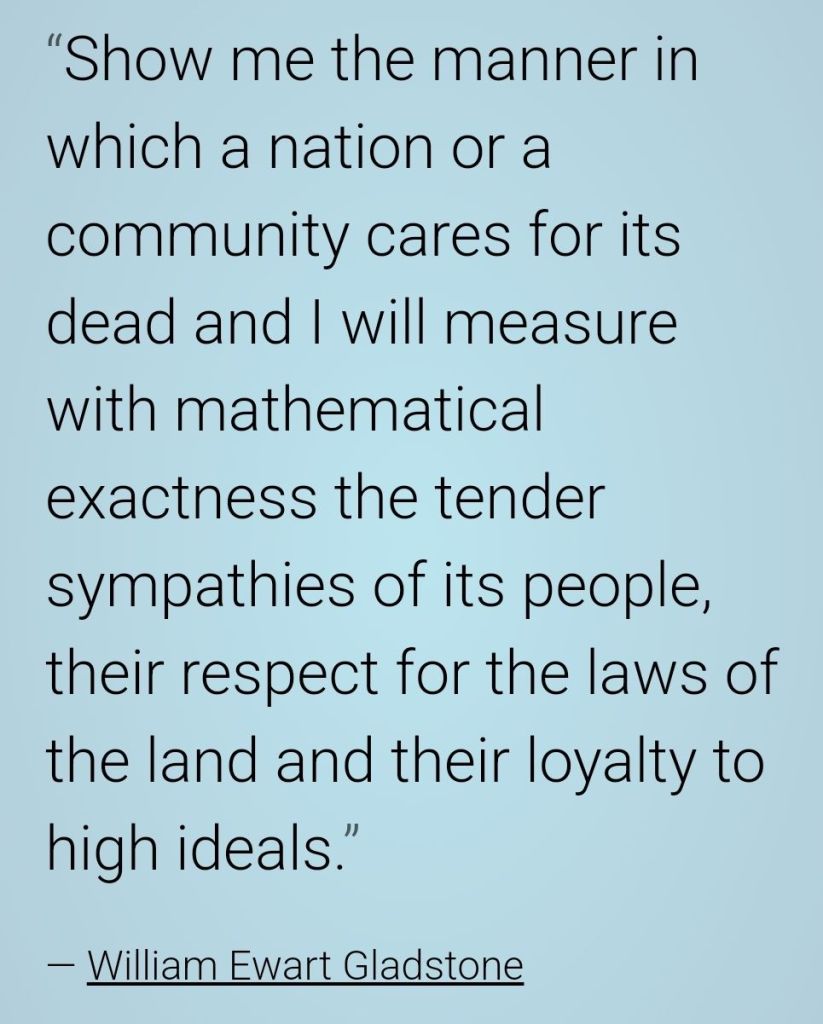
I’ll leave you with a quote I heard a long time ago and then heard at a talk earlier this year (I’m sorry I can’t remember who’s talk it was, but it was online I do remember that much!)
As always, thank you for reading.
MG x
 Mortuary Gem
Leave a comment